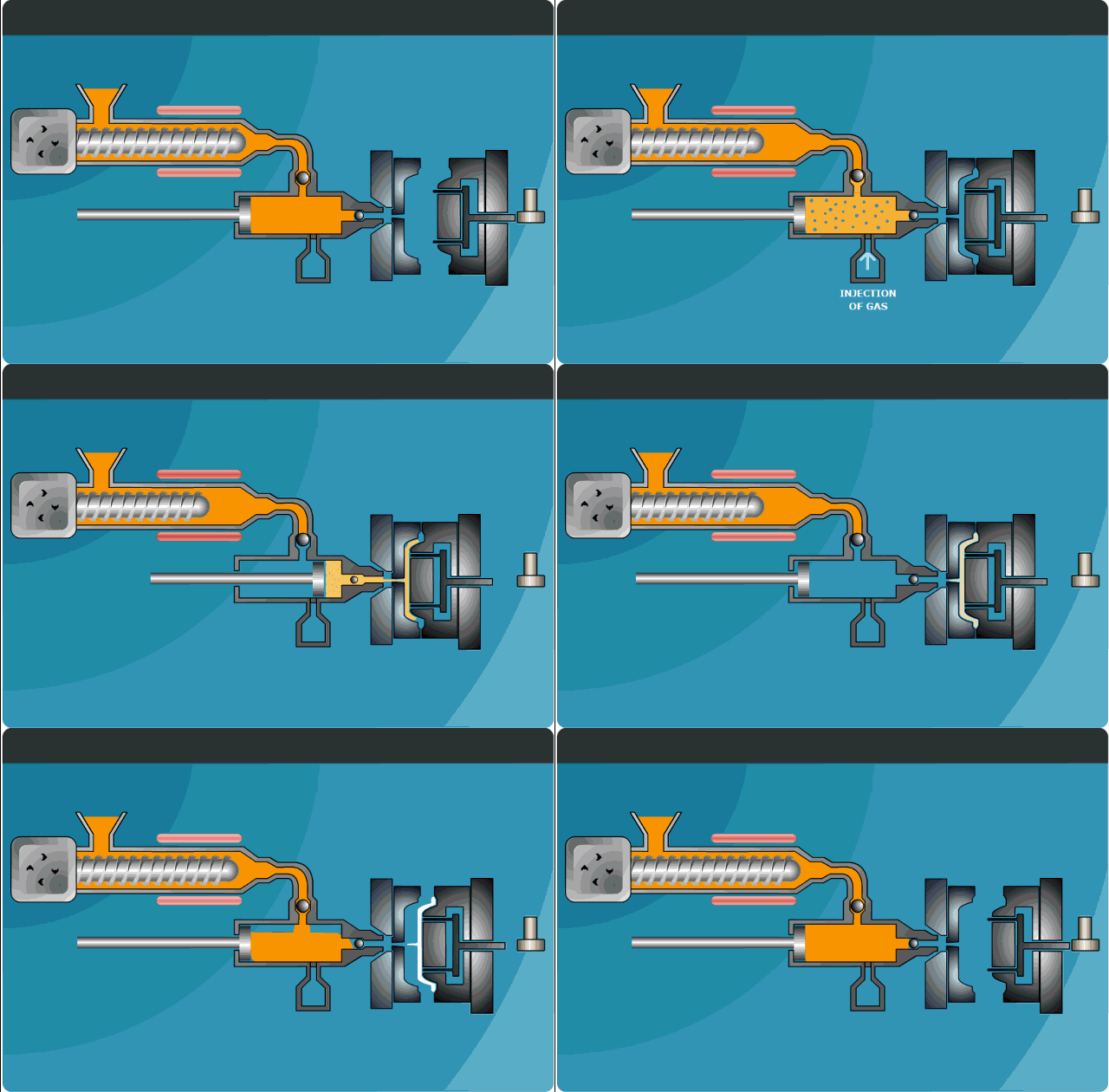
On the production line of injection molding, the runner is like a "plastic highway" connecting the injection molding machine and the mold cavity, undertaking the task of transporting the molten plastic from the barrel to the part. The weight of this "highway" not only affects the material cost but also relates to production efficiency and product quality. How can we accurately calculate the weight of the runner? Let's transform into "plastic engineers" and uncover this secret with interesting and practical methods!
The runner is the flow channel for the plastic melt during the injection molding process, including the sprue, runner, and gate, among other parts. Although the weight of the runner does not constitute the product itself, it accounts for a considerable proportion of the raw material consumption, which can be regarded as the "invisible account book" in injection molding production.
Why calculate the runner weight? Take a simple example. A factory that produces plastic toys manufactures 10,000 products every day. If the weight of the runner for each product can be reduced by 1 gram, 10 kilograms of raw materials can be saved in a day. Calculated at 20 yuan per kilogram of raw materials, 6,000 yuan in costs can be saved in a month! In addition, an excessively heavy runner will increase the cooling time and the injection molding cycle, reducing production efficiency. Therefore, accurately calculating the runner weight is a crucial step in optimizing production and reducing costs.
The core idea of calculating the runner weight is to first calculate the volume of the runner and then calculate the weight based on the density of the plastic. The formula is as follows:\(\text{Runner Weight} = \text{Runner Volume} \times \text{Plastic Density}\)
The runner is usually composed of pipes of different shapes. We can decompose it into simple geometric shapes (such as cylinders, cones, etc.), calculate the volume of each part separately, and then sum them up.
The sprue is the part connecting the injection molding machine nozzle and the runner, generally conical. However, when calculating the volume, it can be approximated as a cylinder. The volume formula for a cylinder is:\(\text{Volume} = \pi \times \text{Radius}^2 \times \text{Length}\)For example, if the diameter of a sprue is 8mm (radius 4mm, i.e., 0.4cm) and the length is 50mm (5cm), then its volume is:\(3.14 \times 0.4^2 \times 5 = 2.512 \text{cm}^3\)
The runner is the channel that distributes the plastic melt from the sprue to each cavity, and it is also mostly cylindrical. Suppose there are 3 runners, each with a diameter of 6mm (radius 0.3cm) and a length of 30mm (3cm). Then the volume of a single runner is:\(3.14 \times 0.3^2 \times 3 = 0.8478 \text{cm}^3\)The total volume of the 3 runners is:\(0.8478 \times 3 = 2.5434 \text{cm}^3\)
The gate is the smallest cross-sectional part of the runner system, with various shapes. Common ones include cylindrical gates and side gates (which can be approximated as cones). Taking a cylindrical gate as an example, if the diameter is 2mm (radius 0.1cm) and the length is 5mm (0.5cm), its volume is:\(3.14 \times 0.1^2 \times 0.5 = 0.0157 \text{cm}^3\)
Add the volumes of the sprue, runner, and gate to obtain the total runner volume:\(2.512 + 2.5434 + 0.0157 = 5.0711 \text{cm}^3\)
Different plastic materials have different densities. The following are the density data of common plastics:
| Plastic Material | Density (g/cm³) |
|---|
| Polyethylene (PE) | 0.91 - 0.97 |
| Polypropylene (PP) | 0.89 - 0.91 |
| Polystyrene (PS) | 1.05 - 1.07 |
| Polycarbonate (PC) | 1.20 - 1.22 |
| Acrylonitrile Butadiene Styrene Copolymer (ABS) | 1.03 - 1.07 |
Suppose we are using ABS material, and we take the density as 1.05 g/cm³.
Substitute the runner volume and plastic density into the formula:\(\text{Runner Weight} = 5.0711 \times 1.05 = 5.324655 \text{ grams} \approx 5.32 \text{ grams}\)
A factory produces a plastic basin made of PP material, and the runner design of its mold is as follows:
Sprue: Diameter 10mm, Length 60mm
Runner: 4 pieces, each with a diameter of 8mm and a length of 40mm
Gate: 8 side gates, each with a diameter of 3mm and a length of 3mm
Calculate the Runner Volume
Volume of the sprue:\(3.14 \times (10 \div 2 \div 10)^2 \times (60 \div 10) = 4.71 \text{cm}^3\)
Total volume of the runner:The volume of a single runner is\(3.14 \times (8 \div 2 \div 10)^2 \times (40 \div 10) = 2.0096 \text{cm}^3\)The volume of 4 runners is\(2.0096 \times 4 = 8.0384 \text{cm}^3\)
Total volume of the gate:The volume of a single gate is\(3.14 \times (3 \div 2 \div 10)^2 \times (3 \div 10) = 0.021195 \text{cm}^3\)The volume of 8 gates is\(0.021195 \times 8 = 0.16956 \text{cm}^3\)The total runner volume is:\(4.71 + 8.0384 + 0.16956 = 12.91796 \text{cm}^3\)
Determine the Plastic Density: Take the density of PP material as 0.9 g/cm³
Calculate the Runner Weight:\(12.91796 \times 0.9 = 11.626164 \text{ grams} \approx 11.63 \text{ grams}\)
Optimize the Runner Dimensions: On the premise of ensuring the smooth filling of the plastic melt, appropriately reduce the diameter and length of the runner. For example, reducing the diameter of the runner from 8mm to 6mm can significantly reduce the runner volume and weight.
Adopt Hot Runner Technology: The hot runner system can keep the plastic in the runner in a molten state at all times, with almost no waste generated, which can greatly reduce the runner weight and raw material waste.
Recycling and Reuse: Crush and granulate the runner waste generated during the production process and add it back to the raw materials for use. However, pay attention to controlling the recycling ratio to avoid affecting the product quality.


